Why Skill, Not Just Connection, Determines Health and Social Outcomes
Executive Summary
Every society depends on infrastructure it rarely names as such: roads enable commerce, schools enable learning, healthcare enables recovery. This paper proposes that relational capacity — the trainable skill to regulate, communicate, repair, and stay attuned within relationships — deserves consideration on similar terms, because nearly every social institution ultimately depends on people's ability to relate to one another effectively. This is offered as an organizing frame, not a discovery: the individual relational competencies discussed here are already documented and, in several cases, already measured by established instruments. The contribution is the frame itself — viewing these competencies collectively, and asking what changes if we treat them as something a society can deliberately build for, rather than something it assumes. The paper states plainly, and early, where this argument is interpretive rather than established, and closes with an explicit account of what it does not claim.
1. Society Is Facing a Relational Challenge
Across healthcare, psychology, education, organizational science, and public policy, relationships show up repeatedly as a factor that shapes outcomes. Yet an important question remains comparatively underexplored: if relationships matter this much, should society devote greater attention to developing the capabilities that sustain them?
The Relational Impact Institute was established to investigate questions of this kind through research, education, and practical application. This paper presents one possible framework for that broader inquiry.
The U.S. Surgeon General's 2023 Advisory named loneliness and isolation a public health crisis, distinguishing structural connection (whether relationships exist) from functional and qualitative connection (what they provide) [1]. Alongside it sit adjacent, well-documented strains: rising rates of reported mental health difficulty, organizational dysfunction and burnout, and caregiver stress that compounds under the weight of aging populations and thinning family networks.
We increasingly recognize that relationships matter. What remains unresolved is how societies intentionally strengthen the capabilities that make healthy relationships possible.
Why This Matters Now
It is worth being direct about why this question is worth asking in 2026 specifically, and about the limits of that argument. Several concerns have gained public and institutional attention roughly concurrently: the Surgeon General's Advisory, rising concern about loneliness, mental health strain, workplace burnout, caregiver stress, and — in a more contested and separately-studied space — declining social trust and polarization.
These are not claimed here as a single phenomenon with a single cause. Each has its own literature and its own drivers — economic, institutional, technological, political — and this paper does not attempt to adjudicate between them or claim relational capacity explains them. What can be said more modestly is that each of these concerns implicates, at some point, the same underlying question: what capabilities allow people to sustain functioning relationships — with partners, patients, colleagues, neighbors — during periods of stress and change? That question is worth asking on its own terms, independent of whether it turns out to be the master key to any of the larger trends it sits alongside.
2. The Infrastructure We Have Overlooked
Infrastructure is what a system depends on but rarely designs for deliberately until it is missing: roads, bridges, electricity, broadband, schools, healthcare systems. Infrastructure is not valued for its own sake — it is valued because it enables other systems to function. A road matters because of what travels on it.
We propose that relational capacity be understood in comparable terms — not because it is more important than physical infrastructure, but because every social institution examined in this paper (families, healthcare, organizations) depends on people's ability to relate effectively, and none of them currently treat that ability as something to design for.
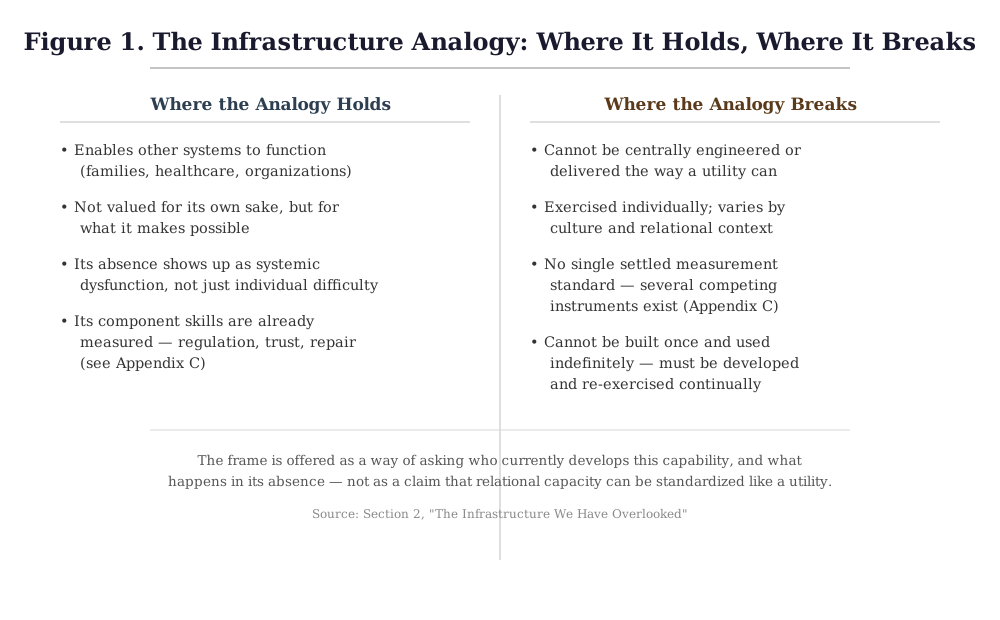
Where the analogy holds, and where it doesn't. Physical infrastructure is centrally engineered, standardized, and its output is measurable in relatively uncontested units (miles paved, megawatts delivered). Relational capacity is none of these things: it is exercised individually, varies by culture and context, and — as Section 4 and Appendix C make clear — is measured today by several different, sometimes competing instruments rather than one settled standard. The infrastructure frame is offered here as a way of asking who currently takes responsibility for developing this capability, if anyone and what happens in its absence — not as a claim that relational capacity can be centrally engineered, delivered, or standardized the way a utility can. Unlike a road or a power grid, relational capacity cannot be built once by a central authority and then simply used; it has to be developed and re-exercised by each person, in each relationship, continually. Readers should hold the metaphor loosely past that point — it motivates the question this paper asks, not the shape of any eventual answer.
See Figure 1.
3. What the Evidence Already Demonstrates
The literature does not need this paper to establish that relationship quality matters. Relationship quality is a well-replicated predictor of health outcomes independent of relationship quantity: supportive relationships predict lower depression, anxiety, and suicide risk; high-conflict relationships predict worse outcomes even absent isolation [2], [3]. In organizational settings, communication quality and psychological safety are independently linked to engagement, retention, and team effectiveness [8]. Structured relational-skills training has been shown in randomized controlled trials to improve satisfaction and psychological health [7], and emotion regulation is consistently associated with healthier relationships and reduced conflict [6].
None of this is new. What is comparatively new is reading this evidence as support for a specific proposition: that these findings, taken together across family, health, and organizational contexts, describe a single underlying capacity worth naming and designing for — rather than a set of separately-managed, domain-specific skills.
4. From Relational Presence to Relational Capacity
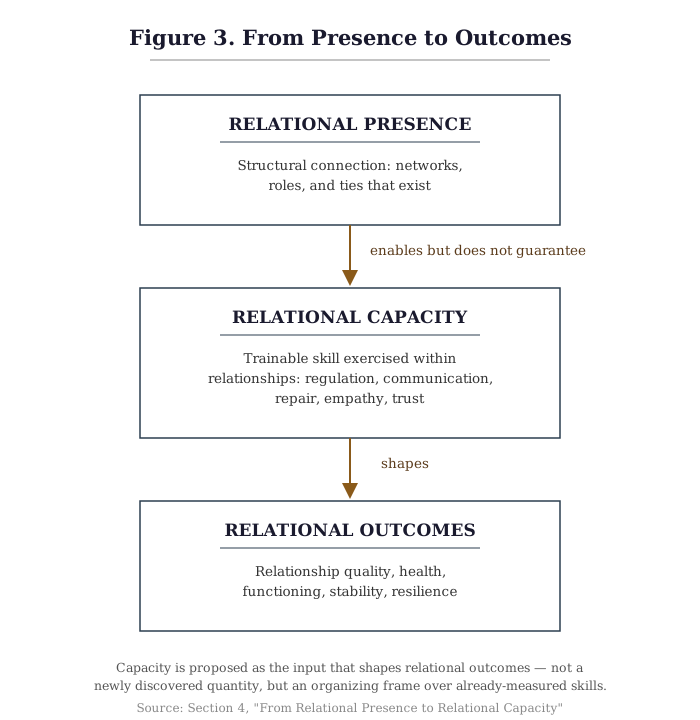
Two people can have equivalent relational presence — comparable social networks, comparable partnership or employment status — and starkly different outcomes, based on the skill exercised within those relationships. This paper calls that skill relational capacity, distinct from the mere fact of connection.
This is stated modestly and deliberately: existing research already measures many of the individual competencies involved — the Couple Relationship Skills Inventory (CRSI), the Dyadic Trust Scale (DTS), the Interpersonal Reactivity Index adapted for couples (IRI-for-Couples), among others (full mapping in Appendix C). This paper does not propose that these competencies are newly discovered. It proposes viewing them collectively, through a shared organizing lens, as components of one capacity rather than a scattered list of unrelated skills. The novelty claimed here is in the frame, not in the underlying skills — a distinction developed further, with explicit caveats, in Section 7.
How this differs from "interpersonal competence" and "relationship quality." This is a fair challenge to raise directly rather than leave implicit. Interpersonal competence, as operationalized by the ICQ [9], describes general social skill across peer relationships broadly — initiation, disclosure, and conflict management with people generally. Relational capacity, as used in this paper, is scoped more narrowly: to sustained, intimate-partner and caregiving relationships specifically, where regulation, repair, and trust operate under different stakes and different stress conditions than general peer interaction. Relationship quality, meanwhile, is typically an outcome measure — a state of a specific relationship at a point in time, as captured by the CRS [11]. Relational capacity is proposed here as an input: the skill that produces that state, in principle exercisable independent of any one relationship's current condition. A person can have high relational capacity and currently be in a low-quality relationship (through no fault of skill — circumstance, a partner's behavior, external stress), or lower capacity within a relationship that is, for now, going well. This input/output distinction — capacity as the skill that shapes quality, not quality itself — is the paper's actual conceptual contribution, more than the term "relational capacity" on its own.
See Figure 3.
5. Why Capacity Matters
Organizing by capability, not because each is new, but because each is foundational to the frame:
- Emotional regulation — the ability to stay physiologically and cognitively steady under relational stress, consistently associated with healthier relationships and reduced conflict [6].
- Communication — patterns that de-escalate rather than compound conflict; the inverse (contempt, criticism, defensiveness, stonewalling) is associated with relationship deterioration [5], though claims about its predictive precision should be read cautiously (see Appendix C).
- Conflict navigation — the capacity to disagree without rupture, and to recover when rupture happens anyway.
- Trust — the Dyadic Trust Scale [13] is the closest existing validated instrument for this domain; RQ Index items were developed independently and are pending benchmarking against it, per Section 8.
- Repair — the ability to re-engage constructively after conflict, distinct from avoiding conflict altogether.
- Empathy — accurate, other-directed understanding; the closest existing validated instrument is the couple-specific IRI-for-Couples [15], against which RQ Index items are likewise pending benchmarking.
Each of these is independently documented. The claim being made is not that any one of them is novel, but that treating them as facets of one capacity — rather than isolated skills addressed by separate programs — changes what an intervention, or an institution, is designed to build.
6. Implications
If relational capacity is treated as a capability worth deliberately developing — not a centrally engineered system, but, as Section 2 notes, something each institution and each person has to build and re-exercise on their own terms — several institutional questions follow, though this paper does not attempt to resolve them here:
- Healthcare. Should caregiver and patient-support relational skill be assessed and supported the way physical health is, given its documented association with recovery and depression/anxiety outcomes [2], [3], [4]?
- Education. Should relational skill instruction have a place alongside academic and vocational curricula, comparable to existing social-emotional learning efforts?
- Public policy. Does loneliness and isolation policy address capacity, or only presence — funding connection opportunities without funding the skill to sustain them?
- Organizations. Should psychological safety and communication skill be treated as a capability worth deliberately developing rather than a soft-skills add-on, given its documented link to retention and effectiveness [8]?
- Communities and families. What would it mean for faith communities, nonprofits, and community organizations to treat relational-skills education as a standing service rather than an occasional program?
These five domains are not evenly matched, and the mismatch is itself informative. Families and organizations already have applied intervention infrastructure to point to — structured, RCT-evaluated curricula like PREP [7], and CRSI-evaluated programs like ELEVATE [10] in the family domain; psychological-safety training in organizational practice [8] — however unevenly each is actually evaluated in the field. Healthcare does not. Caregiver-support and patient-relationship programs exist, but rarely as a specific, evaluated relational-skills curriculum comparable to what already exists for couples (see Appendix B). The evidence that relationship quality affects health outcomes is at least as strong in this domain as in the other two [2], [3], [4] — what is thin is not the evidence, but the intervention infrastructure built on top of it. This is where the infrastructure framing in this paper has the clearest near-term application, precisely because it is the domain where the least has already been built.
These are questions this paper raises, not answers it delivers — the research agenda in Section 8 outlines what would be needed to answer them responsibly.
7. What This Paper Does Not Claim
- This paper does not claim relational capacity is a newly discovered or previously unmeasured construct. It is not — see Appendix C for the existing instruments this paper draws on rather than displaces.
- It does not claim the "loneliness, burnout, caregiver strain, declining trust, polarization" cluster introduced in "Why This Matters Now" shares a single cause, or that relational capacity explains any of them beyond the narrower question of relationship-level functioning.
- It does not claim the infrastructure analogy holds without limit; Section 2 states directly where it breaks down (relational capacity cannot be centrally engineered or delivered the way a utility can).
- It does not claim the capabilities in Section 5 are new; it claims only that organizing them under one frame is a useful, testable proposition.
- It does not claim causal precision about which specific skill deficits drive which specific outcomes. The evidentiary base cited here is correlational, and the most-cited communication-prediction claims (Gottman's divorce-prediction figures) [5] are contested in their strongest popular form — this paper cites the underlying pattern findings, not the uncaveated accuracy claim (see Appendix C).
- It does not present new empirical data. No proposed measurement framework here has been piloted.
Limitations. This is a synthesis paper, not an empirical study. Existing validated instruments referenced throughout (CRSI, CRS, DTS, IRI-for-Couples) were developed and normed on populations that may not match any specific population an implementing organization intends to serve; that mismatch should be tested, not assumed away. The infrastructure framing in Section 2 is an interpretive argument intended to organize institutional thinking, not an empirically established causal model.
8. Research Agenda
This paper's research agenda follows a two-track structure, distinguishing near-term program delivery from the longer validation work still required.
Community Track. The RQ Index is used as-is for program delivery — as a reflection and common-language tool for participants and facilitators, explicitly disclosed as a developing, non-clinical instrument rather than a validated psychometric measure (see Section 7 and the Limitations note above). This track does not wait on the Research Track's results to proceed, because it is not making a validation claim.
Research Track. The Research Track is chartered to do two things in parallel, sequenced by priority:
- Benchmark against existing instruments. Relational Trust and Empathic Accuracy each have a closest existing validated instrument already available — the Dyadic Trust Scale [13] and IRI-for-Couples [15], respectively. The near-term research task for these two domains is establishing convergent or divergent validity against those established measures, not developing new items from scratch.
- Develop original measures. Relational Safety and Relational Impact Awareness have no directly comparable existing instrument (see Appendix C) and represent the genuine open contribution this framework can make. These are the priority targets for original item development and validation work.
The remaining four domains (Emotional Regulation, Communication Stability, Repair & Recovery Agility, Perspective Integration) follow as capacity allows, evaluated against their closest existing partial matches rather than treated as a first-tier research priority.
Underlying this sequencing is a broader validation principle: testing whether a defined pedagogy measurably affects relational capacity using an existing validated instrument (e.g., CRSI or CRS) as the primary outcome measure, with any newly proposed capacity-specific assessment run in parallel as an exploratory measure. This produces a defensible result even before any new instrument is validated, and answers the question a reviewer or funder will ask first: how does this compare to what already exists?
A note on original instrument development. Beyond the two domains where no existing instrument competes directly, there is also a practical rationale for developing original items even where a validated instrument is already available: doing so avoids dependency on third-party licensing and gives the Institute full ownership of its own measurement framework. This is a legitimate, fundable consideration in its own right, distinct from any claim of scientific novelty, and is stated here plainly rather than left implicit.
9. Conclusion
Every society depends on infrastructure that enables people to flourish. Roads enable commerce. Schools enable learning. Healthcare enables recovery. We propose that relational capacity deserves comparable consideration — not because relationships are a private matter set apart from public concern, but because they are the connective tissue through which families, healthcare systems, and organizations actually function. This paper does not claim to have discovered that tissue. It claims that the field has, until now, asked an incomplete question — treating connection as sufficient when the evidence increasingly points to capacity as the more decisive variable — and that this incompleteness is worth taking seriously as a matter of design, not just individual circumstance.
Appendix A: Glossary
Terms are cross-referenced to their closest existing construct or instrument where one exists. Citation numbers correspond to the Works Cited list in Appendix C.
Relational presence — The fact of being embedded in relationship(s): partnered, married, in community, connected through family or workplace ties. Distinguished in the Surgeon General's Advisory as structural connection [1], as distinct from functional connection and relationship quality.
Relational capacity — As used in this paper, the trainable skill exercised within relationships: the ability to regulate emotion under stress, communicate without escalation, repair after rupture, and stay accurately attuned to another person's experience. Not a validated psychometric term; proposed here as an organizing frame over several already-measured competencies (see below). Distinguished from interpersonal competence (general social skill across peer relationships broadly, per the ICQ [9]) by its narrower scope to intimate-partner and caregiving relationships, and from relationship quality (an outcome measure of a relationship's current state, per the CRS [11]) by functioning as the proposed input that shapes that state, rather than the state itself. See Section 4 for the full argument.
Emotional regulation — The ability to modulate one's own emotional state, particularly under interpersonal stress. Closest established construct: emotion regulation as studied broadly in Gross (2015) [6]; within couple contexts, partially reflected in the CRSI "Self-Care" subscale [10].
Relational safety — A felt sense of emotional security within a relationship, sufficient to permit honesty, vulnerability, and repair without fear of escalation or withdrawal. No directly competing standalone instrument identified in the couple/relationship-assessment literature reviewed for this paper. Adjacent, but not equivalent: Gottman's concept of "flooding" [5] and Edmondson's organizational psychological safety [8], neither of which is a couple-specific relational-safety instrument.
Relational trust — Confidence in a partner's reliability, honesty, and benevolent intent. The closest existing validated instrument for this construct is the Dyadic Trust Scale (DTS) [13], a purpose-built measure of the same construct. RQ Index items for this domain were developed independently and have not yet been benchmarked against DTS; per Section 8, DTS is the appropriate validation benchmark going forward.
Communication stability — The capacity to sustain functional, non-escalating communication under stress or disagreement. Partially reflected in the CRSI "Manage" subscale [10] and in the Relational Behavior Interactions Scale [12]. The "Four Horsemen" pattern (contempt, criticism, defensiveness, stonewalling) [5] is a widely cited, though methodologically contested, description of its breakdown.
Empathic accuracy — Accurate, other-directed understanding of a partner's internal experience. The closest existing validated instrument for this construct is the Interpersonal Reactivity Index for Couples (IRIC) [15], itself an adaptation of Davis's general Interpersonal Reactivity Index (IRI) [14]. RQ Index items for this domain were developed independently and have not yet been benchmarked against IRIC; per Section 8, IRIC is the appropriate validation benchmark going forward. Note: this term also names a distinct, unrelated behavioral-measurement paradigm (real-time inference accuracy via video-cued recall) in the broader empathy literature; usage here should be scoped explicitly to avoid confusion with that tradition.
Repair and recovery agility — The capacity to re-engage constructively with a partner after conflict or rupture. Conceptually related to the CRSI "Manage" subscale [10] and to Gottman's coded construct of "repair attempts" [5]; no standalone competing psychometric instrument identified.
Perspective integration — The ability to hold and incorporate a partner's viewpoint alongside one's own. Reflected in the perspective-taking subscale of the IRI [14] and its couple-specific adaptation, the IRIC [15].
Relational impact awareness — Awareness of how one's own behavior affects a partner or relationship over time. No direct match identified in the ICQ [9], CRSI [10], CRS [11], DTS [13], IRI [14], or RBIS [12]; thematically adjacent to general self-monitoring literatures but not operationalized this way for couples in the sources reviewed.
ICQ (Interpersonal Competence Questionnaire) — A 40-item, five-domain self-report measure of interpersonal competence, validated on college-student samples [9].
CRSI (Couple Relationship Skills Inventory) — A 32-item, seven-subscale instrument validated on a large, ethnically and economically diverse adult sample; used as the outcome measure for the ELEVATE relationship-education curriculum [10].
CRS (Couple Relationship Scale) — A single-factor outcome measure for couple therapy and education, re-validated on a community sample with a mean age closely matching a midlife target population [11].
DTS (Dyadic Trust Scale) — An 8-item, unidimensional measure of trust specific to close/romantic relationships [13].
IRI / IRIC (Interpersonal Reactivity Index / for Couples) — A widely used four-subscale measure of dispositional empathy [14], with a couple-specific adaptation targeting empathy toward one's actual partner [15].
RBIS (Relational Behavior Interactions Scale) — A recently developed and validated instrument for couple behavior interactions [12].
PREP (Prevention and Relationship Enhancement Program) — A structured relationship-skills curriculum evaluated through randomized controlled trials [7].
Appendix B: Domain Examples, Expanded
This appendix develops the three implication areas introduced in Section 6 — families, healthcare, and organizations — with the supporting evidence and existing intervention programs in each, along with an honest assessment of how strong that evidence actually is. None of these examples is offered as proof that relational capacity, as an integrated construct, drives these outcomes; each is offered as a domain where the individual capacities discussed in Section 5 have documented, domain-specific evidence behind them.
Families
The evidence. The most-cited body of work on relational skill and family outcomes comes from Gottman's marital-process research [5], which identified specific negative communication patterns — contempt, criticism, defensiveness, and stonewalling, popularly termed the "Four Horsemen" — associated with relationship deterioration, and a corresponding repair-attempt construct associated with relationship stability. This evidence requires a direct caveat. Gottman's original claim of 93–94% predictive accuracy for divorce has been challenged on methodological grounds: the original study did not hold out a cross-validation sample, and later work (Heyman & Slep, 2002; Gottman & Levenson, 2002) found substantially lower predictive accuracy once cross-validated. The underlying pattern findings — that these specific communication behaviors correlate with relationship deterioration — are better supported than the specific predictive-accuracy figure, and this paper relies only on the former.
Existing intervention. The Prevention and Relationship Enhancement Program (PREP) [7] is a structured communication-skills curriculum evaluated through randomized controlled trials, showing improvements in relationship satisfaction and conflict management. A meta-analysis of 117 curriculum-based relationship-education programs — of which PREP is among the most studied — found effect sizes of d ≈ 0.30–0.36 for relationship quality and d ≈ 0.43–0.45 for communication skills, immediately following intervention [16]. Separately, the Couple Relationship Skills Inventory (CRSI) [10] is used as the outcome measure for ELEVATE, an existing federally-funded couple relationship-education curriculum — direct precedent for evaluating community-delivered relationship education against a validated instrument, which is the same evaluation model this paper's research agenda (Section 8) proposes.
Evidentiary strength. Moderate-to-strong for the general claim that specific communication and repair skills predict family relationship outcomes; weak for any specific predictive-accuracy figure. The Hawkins et al. effect sizes [16] are worth reading carefully, not just citing: small-to-medium effects measured immediately post-intervention are a real but modest result, not a transformative one — consistent with this paper's stated intent to avoid overclaiming intervention effectiveness. Existing programs (PREP, ELEVATE) demonstrate that structured, skills-based curricula are both deliverable and evaluable at a community level — this is the strongest existing precedent for the kind of program-plus-measurement model this paper's research agenda proposes.
Healthcare
The evidence. Relationship quality is an independently replicated predictor of health outcomes, distinct from relationship quantity: supportive relationships predict lower depression, anxiety, and suicide risk, while high-conflict relationships predict worse outcomes even absent isolation [2]. This association has been confirmed at scale in meta-analytic mortality-risk research [3]: across 148 studies and 308,849 participants, Holt-Lunstad, Smith, and Layton (2010) found a weighted average odds ratio of 1.50 (95% CI 1.42–1.59) — meaning participants with stronger social relationships had a 50% greater likelihood of survival over the studies' follow-up periods than those with weaker relationships, an effect comparable in magnitude to established risk factors such as smoking cessation. The strength of this association varied by how connection was measured: it was strongest for complex measures of social integration (OR = 1.91) and weakest for simple binary indicators like living alone versus with others (OR = 1.19) — a finding directly relevant to this paper's argument, since it suggests the quality and structure of relationship, not mere cohabitation or presence, carries the effect. The National Academies' 2020 report on social isolation in older adults [4] treats relational connection explicitly as a health-system concern, identifying it as a modifiable factor the health care system currently underaddresses — the closest existing precedent, in a mainstream public health document, to this paper's infrastructure framing.
Existing intervention. Caregiver-support and patient-relationship interventions exist across the healthcare system (e.g., caregiver training programs, chronic-disease patient-support groups), but — unlike PREP or ELEVATE in the family domain — these are heterogeneous, rarely built around a specific relational-skills curriculum, and rarely evaluated against a validated relational-competence instrument. This is a genuine gap: the evidence that relationship quality affects health outcomes is strong, but the corresponding infrastructure of skills-based intervention, comparable to what exists in couple relationship education, is comparatively underbuilt.
Evidentiary strength. Strong for the underlying association between relationship quality and health outcomes. Weak-to-absent for any existing, evaluated, skills-based intervention model analogous to PREP or ELEVATE — this is the domain where this paper's infrastructure argument is most original, precisely because existing intervention is thinnest here.
Organizations
The evidence. Psychological safety — team members' shared belief that the environment is safe for interpersonal risk-taking — is independently linked in peer-reviewed organizational research to team learning behavior and, in related literature building on this work, to engagement and effectiveness [8]. Edmondson's original study followed 51 work teams in a manufacturing company and found that team psychological safety, not team efficacy, predicted learning behavior (asking questions, seeking help, surfacing errors); learning behavior in turn statistically mediated the relationship between psychological safety and team performance — a specific causal pathway, not just a general association, though drawn from a single organizational setting rather than a broad, cross-industry sample. This is squarely a communication- and trust-related construct at the team level, conceptually adjacent to (though not identical to) the individual-level relational-safety and trust domains proposed in Section 5.
Existing intervention. Organizational psychological-safety interventions (structured feedback training, team-norms facilitation) exist and are widely used in leadership-development and organizational-effectiveness practice, though the rigor of evaluation varies considerably by program and is generally weaker than the RCT evidence available for PREP in the family domain.
Evidentiary strength. Strong for the underlying construct (psychological safety predicts team outcomes); moderate-to-weak for any specific intervention's evaluated effectiveness, since much of the applied practice in this space has outpaced its own evaluation literature. Included here as an illustration that the "relational capacity as infrastructure" framing extends beyond intimate-partner contexts, not as a domain this paper claims special expertise in.
Cross-Domain Observation
Across all three domains, the same pattern holds: relationship quality (not just presence) is well-evidenced as a driver of outcomes, and structured skills-based intervention exists in at least one domain (families) with genuine evaluative rigor behind it (PREP, ELEVATE/CRSI). The other two domains (healthcare, organizations) have strong underlying evidence but thinner, less rigorously evaluated intervention infrastructure — which is precisely the gap this paper's infrastructure framing is naming, rather than a gap this paper claims to have already closed.
Appendix C: Evidence Map
A note on development process. The eight RQ Index domains discussed in this appendix were developed independently, prior to and without reference to the instruments catalogued below. The comparison that follows is a subsequent reconciliation against the existing measurement literature, undertaken to responsibly situate this framework relative to prior work — not a description of instruments designed to differentiate from, or compete with, established measures. Where domains overlap substantially with existing validated instruments (see Section 8), this paper's research agenda treats those instruments as the appropriate benchmark for validating the corresponding RQ Index domain, rather than treating overlap as a weakness to be argued away.
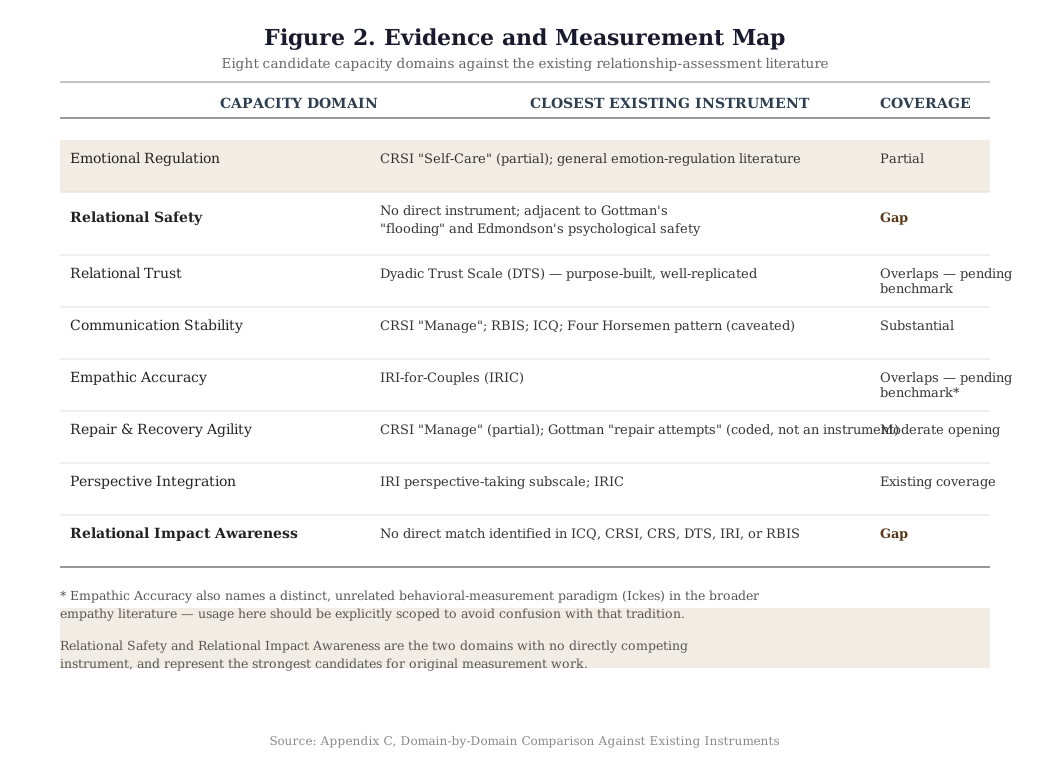
See Figure 2 for a visual summary of the table below.
Domain-by-Domain Comparison Against Existing Instruments
| Capacity Domain | Closest Existing Instrument/Construct | Source | Assessment |
|---|---|---|---|
| Emotional Regulation | CRSI "Self-Care" subscale (partial); general emotion-regulation literature | [6], [10] | Partial overlap; no relationship-specific regulation-during-conflict instrument identified |
| Relational Safety | No direct match in ICQ, CRSI, CRS, or RBIS; adjacent concepts in Gottman's "flooding" and Edmondson's organizational psychological safety | [5], [8] | No competing instrument identified. Strongest candidate for original measurement work; would require new item development |
| Relational Trust | Dyadic Trust Scale (DTS) [13] | [13] | Items developed independently and not yet benchmarked against DTS, the closest existing validated instrument for this construct. Per Section 8, DTS is the appropriate validation benchmark for this domain. |
| Communication Stability | CRSI "Manage" subscale; RBIS; ICQ conflict-management domain; Gottman's Four Horsemen pattern (caveated) | [5], [9], [10], [12] | Significant existing coverage; hardest domain to claim as original |
| Empathic Accuracy | IRI-for-Couples (IRIC) [14], [15] | [14], [15] | Items developed independently and not yet benchmarked against IRIC, the closest existing validated instrument for this construct. Per Section 8, IRIC is the appropriate benchmark for validating this domain. Note: "empathic accuracy" also names an unrelated behavioral-measurement paradigm elsewhere in the empathy literature (Ickes); usage here should be explicitly scoped to avoid confusion. |
| Repair & Recovery Agility | CRSI "Manage" subscale (partial); Gottman's "repair attempts" (coded behavioral construct, not a standalone instrument) | [5], [10] | Conceptual overlap but no standalone competing psychometric instrument identified — moderate opening |
| Perspective Integration | IRI perspective-taking subscale; IRIC | [14], [15] | Existing coverage, both general and couple-adapted versions available |
| Relational Impact Awareness | No direct match identified in ICQ, CRSI, CRS, DTS, IRI, or RBIS | — | No competing instrument identified. Along with Relational Safety, the most genuinely open domain |
Reading this table: Of eight candidate domains, two (Relational Safety, Relational Impact Awareness) currently have no directly overlapping instrument and represent the most defensible claim to originality. Two more (Relational Trust, Empathic Accuracy) overlap substantially with established, validated instruments (DTS and IRIC respectively); per the development-process note above, these domains were developed independently and are treated as pending benchmarking against those instruments, not as claims of originality. The remaining four have partial-to-substantial overlap with existing constructs and should be framed as synthesis pending validation, not invention.
Future Research Priority
Relational Safety and Relational Impact Awareness are the two domains best positioned for original instrument development, since no directly competing measure exists in the sources reviewed. All other domains should be evaluated using the closest existing validated instrument (principally CRSI [10] or CRS [11]) as the primary outcome measure, per the sequencing proposed in Section 8 of the body.
Works Cited
- Murthy, V. H. (2023). Our Epidemic of Loneliness and Isolation: The U.S. Surgeon General's Advisory on the Healing Effects of Social Connection and Community. U.S. Department of Health and Human Services, Office of the Surgeon General.
- Umberson, D., & Montez, J. K. (2010). Social Relationships and Health: A Flashpoint for Health Policy. Journal of Health and Social Behavior, 51(S), S54–S66. doi:10.1177/0022146510383501
- Holt-Lunstad, J., Smith, T. B., & Layton, J. B. (2010). Social Relationships and Mortality Risk: A Meta-analytic Review. PLoS Medicine, 7(7), e1000316. doi:10.1371/journal.pmed.1000316
- National Academies of Sciences, Engineering, and Medicine (2020). Social Isolation and Loneliness in Older Adults: Opportunities for the Health Care System. Washington, DC: The National Academies Press. doi:10.17226/25663
- Gottman, J. M. (1994). What Predicts Divorce? The Relationship Between Marital Processes and Marital Outcomes. Hillsdale, NJ: Lawrence Erlbaum Associates. Methodological caveat: Gottman's original claim of 93–94% divorce-prediction accuracy has been challenged; cross-validation studies (Heyman & Slep, 2002; Gottman & Levenson, 2002) found substantially lower predictive accuracy once findings were cross-validated rather than fitted to the original sample. This paper cites only the underlying associative pattern findings (specific communication behaviors correlating with relationship deterioration), not the uncaveated predictive-accuracy figure.
- Gross, J. J. (2015). Emotion Regulation: Current Status and Future Prospects. Psychological Inquiry, 26(1), 1–26. doi:10.1080/1047840X.2014.940781
- Markman, H. J., et al. (1980s–present). Prevention and Relationship Enhancement Program (PREP). University of Denver; evaluated across multiple randomized controlled trials; curricula maintained by PREP Inc. Primary early publication: Markman, H. J., Stanley, S. M., & Blumberg, S. L. (1994). Fighting for Your Marriage. Jossey-Bass. [PREP]
- Edmondson, A. (1999). Psychological Safety and Learning Behavior in Work Teams. Administrative Science Quarterly, 44(2), 350–383. doi:10.2307/2666999 [Corrected: issue number was previously misstated as 44(4).]
- Buhrmester, D., Furman, W., Wittenberg, M. T., & Reis, H. T. (1988). Five Domains of Interpersonal Competence in Peer Relations. Journal of Personality and Social Psychology, 55(6), 991–1008. doi:10.1037/0022-3514.55.6.991 [ICQ]
- Adler-Baeder, F., et al. (2022). Validating the Couple Relationship Skills Inventory. Family Relations, 71(1), 279–306. doi:10.1111/fare.12590 [CRSI. Corrected: volume/issue/pages were previously misstated as 70(5), 1557–1575.]
- Starken, P., Stratton, P., Kieran, A., Sherbersky, H., Shepherd, M., Galbraith, M., Whittinger, N., Pomini, V., Kunsang Yang Yang, Nearchou, F., Shevlin, M., & Carr, A. (2026). Further Validation of the Couple Relationship Scale. Journal of Marital and Family Therapy, 52(1), e70100. https://doi.org/10.1111/jmft.70100 [CRS]
- Harel, T., & Koslowsky, M. (2024). Development and Validation of the Relational Behavior Interactions Scale for Couples. Scientific Reports, 14(1), 8086. doi:10.1038/s41598-024-58901-2 [RBIS]
- Larzelere, R. E., & Huston, T. L. (1980). The Dyadic Trust Scale: Toward Understanding Interpersonal Trust in Close Relationships. Journal of Marriage and the Family, 42(3), 595–604. doi:10.2307/351903 [DTS]
- Davis, M. H. (1983). Measuring Individual Differences in Empathy: Evidence for a Multidimensional Approach. Journal of Personality and Social Psychology, 44(1), 113–126. doi:10.1037/0022-3514.44.1.113 [IRI]
- Péloquin, K., & Lafontaine, M.-F. (2010). Measuring Empathy in Couples: Validity and Reliability of the Interpersonal Reactivity Index for Couples. Journal of Personality Assessment, 92(2), 146–157. [IRIC]
- Hawkins, A. J., Blanchard, V. L., Baldwin, S. A., & Fawcett, E. B. (2008). Does Marriage and Relationship Education Work? A Meta-Analytic Study. Journal of Consulting and Clinical Psychology, 76(5), 723–734. Meta-analysis of 117 curriculum-based marriage/relationship education programs, including PREP; reports effect sizes of d ≈ 0.30–0.36 for relationship quality and d ≈ 0.43–0.45 for communication skills, immediately following intervention.